

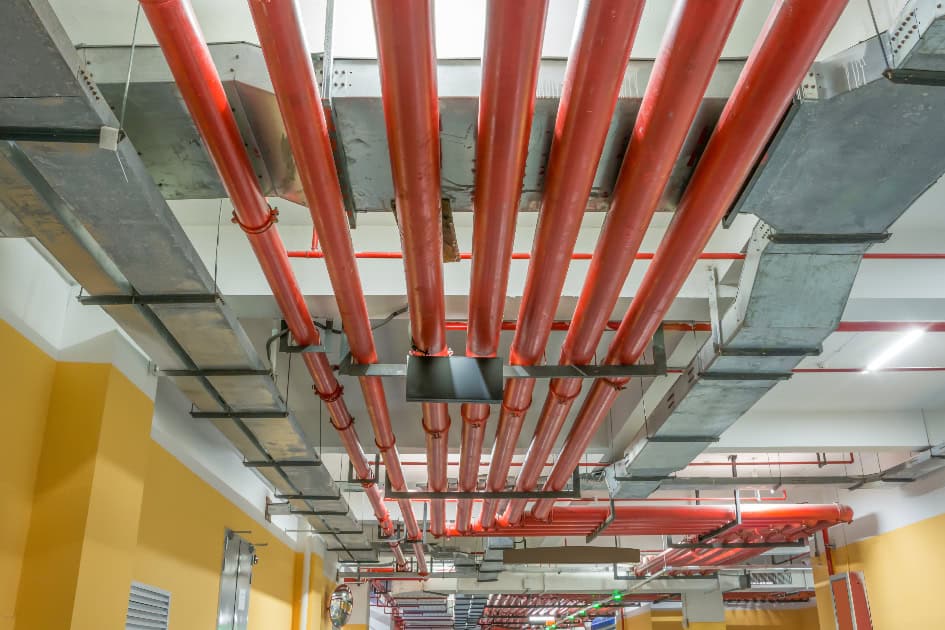
What are Firestop Sealants?
Firestop Sealants are used to seal small openings/gaps through penetrants (such as civil pipes, ducts, electrical cables, etc.) passing through walls or floors in buildings. The purpose of fire sealants is to seal any small openings (up to 2-4 cm in diameter) so as to prevent a fire from traveling from a fire area/compartment to another area/compartment of a building or structure. Fire Sealants, like all passive fire products, have a fire rating which indicates the time it will stop fire for. Any passive fire product will have a fire rating of up to a maximum of 4 hours.
There are different types of Fire Sealants used for their individual properties. Firestop Sealants can be silicone, ablative or intumescent. They can be elastomeric which indicates their expansion or movement capability from 25% – 50%. Silicone Firestop Sealants are elastic, maintain stability in high & low temperatures and is resistant to other chemicals, moisture, and weathering. Unlike some adhesives, silicone sealants must cure. Ablative FireStop Sealants absorb the energy of a fire to protect what is underneath, buying valuable time. They work by consuming heat energy from fire, releasing it in the form of gases as they char to form insulation. Intumescent Firestop Sealants are used mainly around plastic pipes/materials that penetrate through walls and floors. Intumescents swell as a result of heat exposure, thus increasing in volume and decreasing in density. Intumescent sealants are ideal for use with plastic materials/pipes as the intumescent material is used in accordance with the diameter of a pipe so as to assure that the expansion of the intumescent material is wide enough to seal the opening of the pipe diameter.
Types of Firestop Sealants
There are various kinds of fire stop sealants based on the unique characteristics of each. Fire stop sealants may be made up of silicon, ablative or intumescent. Elastomers indicate the ability to expand or move from 25%-50% based on the product.
Silicone Fire Stop Sealants are elastic, temperature stable, chemical resistant, moisture resistant and weather resistant. Silicone fire stop sealants are not similar to adhesives because they have to be cured before becoming effective.
Ablative Firestop Sealants are designed to contain the heat energy of the fire for the purpose of protecting whatever is below. This is done by absorbing the heat energy of fire, releasing it as gases when charring to create insulation.
Intumescent Firestop Sealants are mostly used around plastic pipes and other penetrations through walls and floors. These fire stop sealants swell upon exposure to heat, thereby increasing volume and lowering density – closing the gap created by a melted plastic pipe.
Where Are Firestop Sealants Used?
Electrical & Data Installations
The most common building penetrations involve cable trays, conduit and data cables running through a fire rated wall. A single unsealed bundle of cables can enable fire and toxic smoke to spread silently between floors or compartmentalises within minutes.
HVAC & Mechanical Systems
When ducts, ventilation pipes and air handling units pass through a building’s rated structure, they produce sizable openings. Air sealing is applied around these penetrations to prohibit flames from using ducts for progression and expansio
Plumbing & Civil pipes:
Metal and plastic plumbing and civil pipes both need firestopping, but different types of sealants are needed. For example, heat-conductive metal pipes an ablative and intumescent sealants are suitable; but the melting of plastic pipes creates voiding. That is why they require intumescent and plastic pipe intumescent fire sealants that expand upon contact with fire.
High-Risk Buildings & Critical
Infrastructure Whether it be a hospital, data center, an airport or an underground metro station, requirements for fire stopping are extremely high and specified. A hospital needs afire- Compartmentation in case an emergency is required, not to jeopardize the lives of the patient with his/her physical limitations. Just smoke in a data center can devastate the equipment worth crore.”
Residential & Commercial Building
It is now mandated by all modern building codes around the world including India, not to let out all the service penetrations (through any service penetration- whether in a housing society, IT park, shopping mall) that goes through fire-rated walls or slabs without fire stopping a service through the penetration opening.
How to Choose the Right Fire Stopping Sealant
One of the biggest, and arguably most dangerous, errors you could make when using passive fire protection is choosing the wrong type of fire sealant for your penetration. Here’s a quick run through for help you decide between two widely used types.
| Sealant Type | Best For | Works With | Temperature Resistance |
Typical Fire Rating |
|
Silicone |
Joint sealing, construction gaps | Metal pipes, cables, glass | Up to 1000°C |
Up to 4 hours |
|
Ablative |
Cable & civil pipe penetrations | Cables, metal pipes, ducts | Sustained high heat |
Up to 4 hours |
|
Intumescent |
Plastic pipe penetrations | PVC & CPVC pipes, plastic conduits | Expands at ~150°C |
Up to 4 hours |
Beyond the sealant type, also evaluate:
- Fire-rating required – Confirm the fire rating for the existing wall or floor assembly and choose sealant that matches or surpasses the existing rating.
- Tested and certified products – Check that the product has been tested to the appropriate standard for your country.
- Manufacturer’s instructions – Even if a sealant is of the correct type for the situation, incorrect installation will lead to it failing during a fire, due to inappropriate depths, using wrong materials for backing and failure to allow for curing. Using colors. Site supervisors and inspectors frequently use fire stop sealants in specific colors, so the system that is used is readily distinguishable.
Fire Rating Explained – What Does 1-Hour or 4-Hour Mean?
What a “2-hour fire rating” on a fire sealant (or other passive fire product) means is that A product that is given a 2-hour fire rating under fire test conditions has demonstrated the ability to contain fire, heat and smoke for 2 hours.
This is not an intention to extinguish a fire; rather the products are intended to maintain their integrity within a single zone compartment of building long enough for: building occupants to evacuate safely emergency services to arrive structure damage limited
It’s also good to note that fire rated sealants generally come in 1 hr, 2 hr and 4 hr ratings. Based on the fire rating of the wall or floor assembly, your fire stopping sealant rating would be that same fire rating.
Not every sealant used to fill a gap provides fire protection. Only tested and listed firestop sealant products, installed in accordance with the manufacturer’s tested system design and with all required system components in place, are designed to perform as intended during a fire.
What Else to Look for in a Firestop Sealant
As depending on its use or the application where it would be used to decide which sealant would be appropriate. When evaluating the fire rating of sealant and the actual product’s tests it is essential to ensure that the particular product has actually been fire tested under various fire conditions and in accordance with the test standards applied within a country and that the sealant has been installed in accordance with the manufacturer’s instructions.
Vijay Systems provide technical advice in the selection and fitting of both reliable firestop sealants and smoke seal systems. Their technical knowledge of fire stop systems and professional installation ensures every builder and owner can be assured that the building’s passive fire protection can comply with regulations and functions appropriately. Highly precise and technical, installation of fire stopping sealants should only be undertaken by qualified personnel following all necessary precautions.
Common Mistakes When Applying Firestop Sealants
Even the best-specified fire sealant will fail if it is not applied correctly. These are the most frequently observed mistakes on site:
1. Using normal silicone sealant instead of certified firestop sealant
Regular building sealants look almost the same as fire stopping sealants, and have no fire resisting properties. This is one of the most dangerous mistakes on a building site, and is often attributed to saving money.
2. Insufficient depth
It is essential that most firestop sealants are applied to a minimum depth (25mm or more is standard), so as to reach the appropriate level of performance. A bead of sealant only covering the width of the gap will be able to shed no fire integrity at all.
3. Failing to include backing in many fire sealing systems
It is necessary to introduce a mineral wool or ceramic fibre backing prior to the fire sealant application. If this does not happen the structural stability under fire is reduced.
4. Mismatching sealant type to pipe material
If you apply an intumescent sealant for use with a metallic pipe to seal around an ablative one the sealant will fail to activate if the pipe is melting, leaving a void to let fire and smoke through.
5. Penetrations left unsealed during rework
It is common for MEP contractors, when altering an existing layout, to cut new openings or enlarge new and existing openings. When openings are reworked, they require re-firestopping, and leaving them unsealed, even for a short period, poses a significant compliance risk.
Conclusion
Fire protection is essential for preserving life and property. Firestops can save lives and significantly reduce damage to building structures and assets. Fire-resistant compartments are designed to contain a fire within a specific area, helping to prevent its spread. Firestop products play a vital role in maintaining the integrity of these compartments. At Vijay Systems, we provide high-quality firestop solutions designed to help maintain compartmentation and support fire safety requirements. Therefore, it is important that all openings and gaps in buildings are properly firestopped to restrict both horizontal and vertical fire spread.