

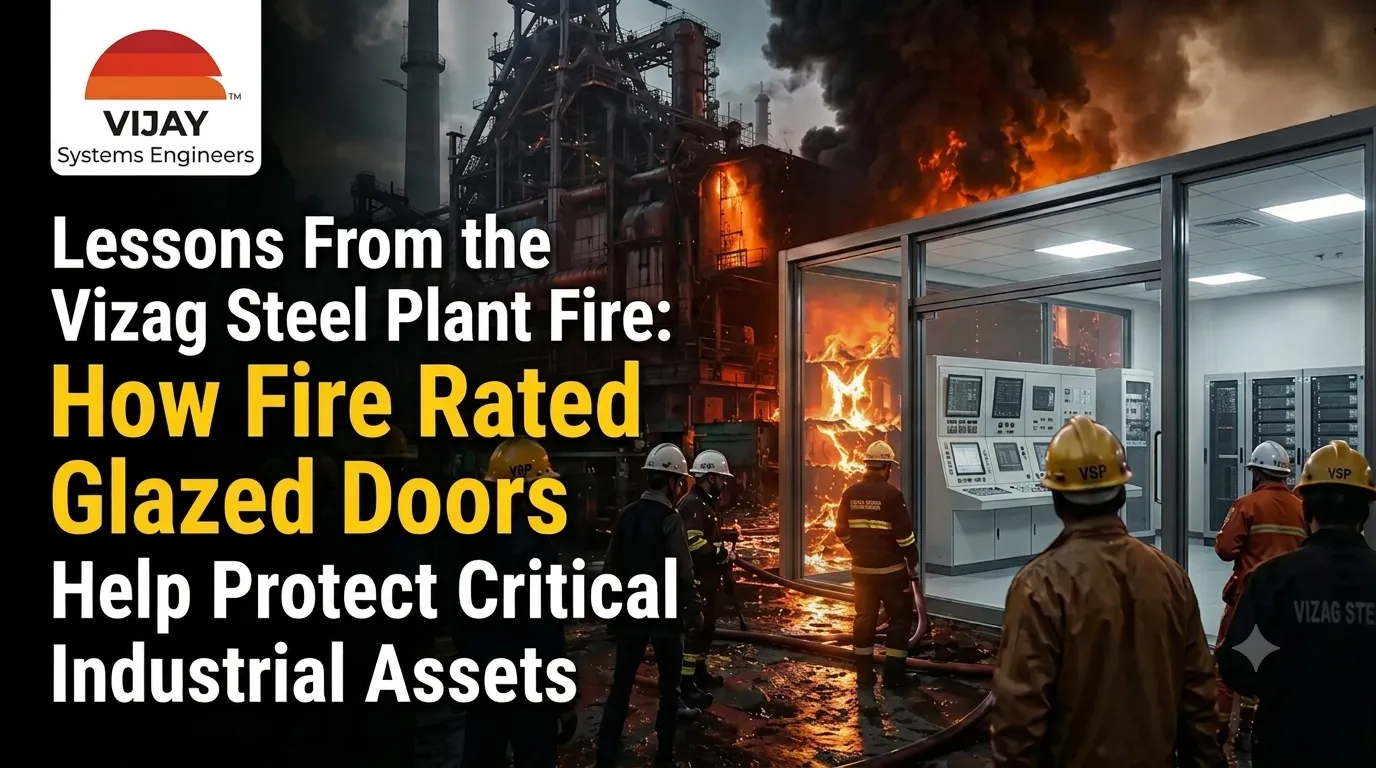
Lessons From the Vizag Steel Plant Fire: How Fire Rated Glazed Doors Help Protect Critical Industrial Assets
Industrial fires are not rare incidents. They happen fast and spread even faster. The Vizag Steel Plant fire is one such reminder. It showed how quickly a small failure can turn into a large emergency in a high-risk facility. In such environments, every second matters. Every barrier matters even more.
Factories, steel plants, and heavy industrial units run on heat, pressure, and continuous operations. This makes them vulnerable if fire safety systems are not strong enough. Structural steel can weaken quickly under high temperatures, which is why intumescent paint for steel is used as one of the passive fire protection measures for protecting structural members. Smoke spreads through open corridors. Equipment damage can stop production for weeks.
This is where modern passive fire protection becomes important. Among these systems, fire rated glass doors play a critical role. They do not just act as entry points. They act as controlled safety barriers. They help slow down fire movement while still allowing visibility and safe movement.
In recent years, industries in India and the UK have started focusing more on advanced containment systems like Fire rated glazing systems. These solutions are now seen as essential, not optional.
What The Vizag Steel Plant Fire Teaches Us About Containment
Large industrial sites operate like connected networks. One section supports another. A fire in one zone can easily move into the next if separation fails.
The Vizag incident highlighted a few important realities:
- Fire spreads faster in open industrial layouts
- Heat can damage nearby machinery even without direct flames
- Downtime after fire damage leads to major financial loss
In such situations, containment becomes the first line of defence. Not just suppression systems, but fire rated walls and partitions that help hold fire within a limited area.
This is where fire rated glass doors become relevant. Unlike standard doors, they are designed to resist high temperatures while still allowing visibility. Workers and safety teams can see what is happening without opening dangerous zones.
Along with this, Fire rated glazing systems support compartmentation. They allow light and visibility while preventing fire and smoke from passing through critical zones.
These systems do not stop fire completely. But they slow it down. And in industrial safety, slowing down fire can save entire sections of a plant.
Why Visibility Matters in High-Risk Industrial Zones
In many industrial environments, solid walls alone are not practical. Teams need visibility between control rooms, production areas, and emergency exits.
But visibility should not come at the cost of safety. That is where fire rated glass doors offer a balanced solution.
They allow:
Clear visual monitoring during normal operations
- Faster response during emergencies
- Safer evacuation guidance
- Reduced panic due to visible surroundings
During fire situations, confusion often causes more damage than flames. When people can see through barriers, decision-making becomes faster.
Fire rated glazing systems are designed to maintain this visibility even under high heat conditions. The glass does not shatter easily. It holds its integrity for a defined period, giving time for evacuation and response.
This combination of transparency and resistance is what makes them suitable for industrial plants, metro stations, power units, and warehouses.
How Fire Rated Glazed Doors Perform Under Extreme Conditions
Industrial fires are not predictable. Temperatures rise quickly. Smoke pressure increases. Structural elements begin to weaken.
In such conditions, fire rated glass doors are tested to perform in real stress situations. They are not standard glass installations. They are engineered systems with multiple protective layers.
Key performance aspects include:
- Resistance to high heat exposure
- Controlled integrity under pressure
- Prevention of flame penetration
Along with this, Fire rated glazing systems are designed to maintain compartmentation. This means they divide a building into fire-safe sections. Even if one zone is affected, others remain protected for a defined time.
This time window is extremely important. It allows:
- Safe evacuation of workers
- Emergency shutdown of machinery
- Fire control teams to act effectively
- Reduction of secondary damage
In large industrial setups, even 30 to 120 minutes of resistance can make a major difference in loss control.
Designing Safer Industrial Infrastructure in Modern Times
Industrial safety is no longer just about alarms and sprinklers. It is about building systems that work together. Structural design, materials, and fire protection all play a role.
Modern facilities now include:
- Zoned fire compartmentation
- Heat resistant structural materials
- Automated detection systems
- Passive fire protection installations
Within this system, fire rated glass doors are becoming a standard feature. They are used in control rooms, emergency exits, and separation corridors.
Similarly, Fire rated glazing systems are used in areas where transparency and safety must exist together. This includes monitoring rooms, plant observation areas, and high traffic corridors.
The goal is simple. Reduce risk before it spreads. Not after it spreads.
This shift in design thinking is helping industries reduce downtime and improve worker’s safety.
What Industrial Safety Teams Should Focus On
Many industrial fire incidents show one pattern. Safety systems are often present, but not fully integrated.
To improve protection, teams should focus on:
- Proper fire zoning of industrial spaces
- Regular inspection of fire barriers
- Training staff for emergency response awareness
Most importantly, physical barriers like fire rated glass doors should not be treated as secondary elements. They are active safety systems.
At the same time, Fire rated glazing systems should be planned during the design stage, not added later. Early integration ensures better performance and compliance.
When these systems are part of the original architecture, they perform more effectively during emergencies.
Safer Infrastructure Starts with Smarter Choices
The Vizag Steel Plant fire is a reminder that industrial safety cannot depend on active systems alone. Sprinklers and alarms help, but they do not stop fire movement on their own.
Physical containment is equally important. This is where fire rated glass doors and Fire rated glazing systems become essential parts of industrial safety planning. They slow down fire, control smoke, and protect critical operations long enough for response teams to act.
At Vijay Systems, we focus on building these protective solutions for real-world industrial needs. We design and supply systems that support safer infrastructure, better visibility, and stronger fire compartmentation. Our approach is simple. We help industries reduce risk before it becomes damaged.